





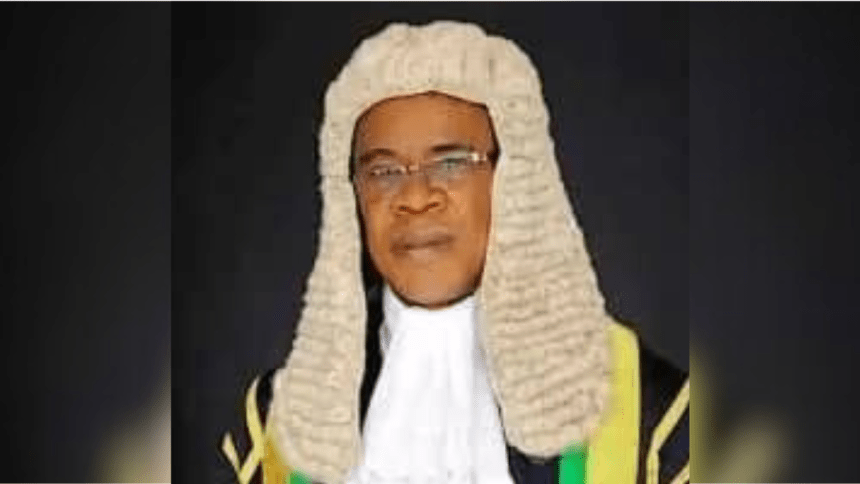
The National Judicial Council (NJC) has suspended three Judges for one year without pay.
The affected judges are Justice Jane E. Inyang of the Court of Appeal, Uyo Division; Justice Inyang Ekwo of the Federal High Court, Abuja Division, and Justice Aminu Baffa Aliyu of the Federal High Court in Zamfara State.
NJC also directed the governor of Imo State, Hope Uzodimma, to reverse the appointment of the acting Chief Judge of the State, Justice Theophilus Nnamdi Nzeukwu.
The decisions, among others, were taken by the Council at the end of its 108th meeting held on April 29 and 30, 2025.
The NJC also asked the acting Chief Judge Imo State to show cause within seven days why disciplinary action should not be taken against him.
Also, NJC asked the President, Customary Court of Appeal, Imo State, to show cause within seven days why disciplinary action should not be taken against him for presiding over the JSC meeting that recommended the appointment of the Acting Chief Judge of the State, contrary to the provision of the Constitution.
A statement issued by the Deputy Director of Information of the NJC, Kemi Babalola, on Wednesday, also said that the council empanelled nine committees to investigate 27 judicial officers for various allegations of misconduct.
Other decisions taken by the council included the dismissal of 29 petitions and the issuance of a letter of caution to a Federal High Court Judge.
It said that, ‘’appointment of Judicial Officers henceforth open to public scrutiny and also directed the Imo State Governor, Senator Hope Uzodimma to appoint the most senior Judicial Officer in the State High Court’s hierarchy as the acting Chief Judge of the State in conformity with Section 271 (4) of the Constitution of the Federal Republic of Nigeria, 1999 (as amended).’’
The NJC meeting, which was chaired by the Chief Justice of Nigeria, Hon. Justice Kudirat Kekere-Ekun, resolved that the constitutional provision on the appointment of an acting Chief Judge of a State does not give room for discretion. Section 271(4) of the Constitution provides: “If the office of the Chief Judge of a State is vacant or if the person holding the office is for any reason unable to perform the functions of the office, then, until a person has been appointed to and has assumed the functions of that office, or until the person holding the office has resumed those functions, the Governor shall appoint the most senior Judge of the High Court to perform those functions.”
The President of the Customary Court of Appeal, Imo State, Hon. Justice V. U. Okorie, ‘‘who acted as Interim Chairman of Imo State Judicial Service Commission and recommended the appointment of Justice Nzeukwu is required to show cause within seven days why disciplinary action should not be taken against him for his complicity in the recommendation.
‘‘Specifically, in its resolution, the Council suspends Justice Jane E. Inyang, Court of Appeal, Uyo Division, for one year without pay, as the Investigation Committee found His Lordship to have breached Rule 3 (5) of the Revised
‘‘Code of Conduct for Judicial Officers. Justice Jane E. Inyang was found to have abused his office by issuing inappropriate Ex parte Orders for the sale of Hon. Udemesset’s’s petrol station and other businesses at interlocutory stage of the case.’’
The act of judicial misconduct was said to have occurred while His Lordship presided over Suit No. FHC/UY/CS/46/2023, at the Federal High Court, Uyo Judicial Division, before his elevation to Court of Appeal.
Furthermore, Justice Inyang Ekwo of the Federal High Court, Abuja Division, was also placed on suspension for one year without pay and was also placed on the watch list for five years and barred from elevation for five years as well.
The complaints against Justice Ekwo arose from Charge No. FHC/ABJ/CR/184/2021, wherein His Lordship delivered a Ruling in a pending application without hearing the parties.
He was said to have ignored an application to set aside the proceedings of the court conducted in the absence of the parties. Subsequently, he proceeded to deliver a ruling dismissing the case against the defendants.
‘‘Consequently, His Lordship was found to have violate Rules 3.1 and 3.3 of the 2016 Revised Code of Conduct for Judicial Officers of the Federal Republic of Nigeria,’’ the NJC said.
About The Author





More Stories
ADC will not tolerate imposition of candidates, indiscipline – Mark
US govt takes indirect jab at Nigerian governors for spending billions on luxury houses while urging citizens to tight their belts
Fashola weighs in on Lagos streets renaming, says state’s history must be preserved